
In the previous post, I categorized and organized the complex 2026 AI ecosystem into four core types.
⬇️ Read the previous post
[AI Basics 2026 | Ep.1] AI Ecosystem Guide: Comparing ChatGPT, NanoBanana, Notion AI, and Copilot)
In this post, I will focus on Large Language Models (LLMs)—the most fundamental and well-known examples, including ChatGPT, Claude, and Gemini.
They Look Alike, but Are They the Same?
To start with the conclusion, ChatGPT, Gemini, and Claude only look similar on the surface; they are entirely different tools with distinct reasoning styles and specialized strengths.
ChatGPT, Gemini, and Claude are already deeply integrated into our daily lives. Most people are likely using at least one of these services, but not many truly understand the precise differences between these three platforms.
The image below shows the initial screens for each service. As you can see, the appearance and usage patterns are almost identical.

However, these three LLMs are much more different than they appear. Their underlying reasoning styles are fundamentally different. As a result, the areas where they excel also differ, and to complete your tasks most efficiently, you must identify the LLM best suited for the job. This requires a clear understanding of each model's unique characteristics.
The era of simply asking "which one is smarter" is over. Now, it is time to choose a partner that best aligns with the nature of your work and your own reasoning style.
ChatGPT vs. Gemini vs. Claude: What Sets Them Apart?
Each model has evolved from distinct data resources and development philosophies, which directly translates into noticeable differences in output quality.
(1) 무엇을 배웠나? – 학습 데이터의 차이
The first factor you should verify is what each model has studied.
| LLM | Training Data | Training Period (Latest Model) | Real-time Info Supplementation |
| ChatGPT | Public web and 3rd-party private data | GPT-5: ~2024.10 | Browsing-based real-time search |
| Gemini | Google proprietary data (Search, YouTube, Books, etc.) | Gemini 3: ~2024.01 | Google Search Engine RAG integration |
| Claude | Refined and self-critiquing synthetic data | Opus 4.5: ~2025.05 | Safety-oriented refined training |
![[2026 AI 기초 | 2편] ChatGPT vs Gemini vs Claude 완벽 비교 | 3대 LLM 차이점과 선택 가이드](https://studio.bloomeraldcity.com/wp-content/uploads/2026/02/image-7.png "[AI Basics 2026 | Ep.2] ChatGPT vs. Gemini vs. Claude: A Comprehensive Comparison | Differences and Selection Guide")
(2) 어떤 방식으로 사고하나? – 학습 지향점의 차이
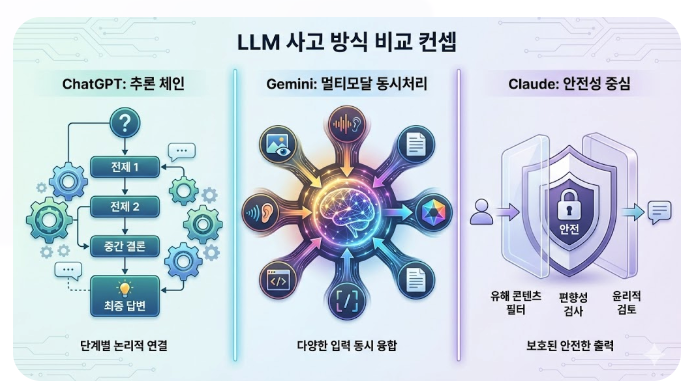
The differences aren’t limited to data alone; the reasoning philosophies pursued by each LLM are also fundamentally different.
- ChatGPT focuses on maximizing ‘System 2’ thinking—namely, a deep and logical reasoning process.
- Gemini is built from the ground up to be a 'native multimodal' AI, simultaneously understanding text, images, audio, and video.
- Claude aims for 'human-centric intelligence,' understanding emotional nuances and delivering the safest responses.
| LLM | Learning Objectives | Core Technologies |
|---|---|---|
| ChatGPT | Maximizing complex logical reasoning capabilities | Training focused on mathematical proofs, programming code, and scientific papers; Advanced reasoning via CoT (Chain of Thought) techniques |
| Gemini | Native Multimodality | Processes text, images, audio, and video within the same sequence; Model architecture is designed for native multimodal understanding |
| Claude | Safe and logical agents | Intensive training on large-scale code repositories and engineering workflows; Constitutional AI: HHH (Helpful, Honest, Harmless) |
Which AI Should You Use for Different Situations?
It is wisest to choose your tool based on your profession and the nature of the task at hand; generally, ChatGPT excels at complex strategic planning, Gemini shines in massive data analysis, and Claude is the preferred choice for high-quality writing and coding.
(1) For Complex Reasoning and Strategic Planning: ChatGPT
I highly recommend ChatGPT for business leaders and professional researchers. In particular, the o-series models leading the 2026 market possess an incredibly high 'density of intelligence.' Moving beyond mere information retrieval, it excels at formulating hypotheses for complex, open-ended problems and identifying logical vulnerabilities. Additionally, its memory feature, which remembers user preferences, serves as your most powerful weapon as a personalized strategic partner.
| Application Area | Specific Task Examples |
|---|---|
| Personalized Memory-based Work | Rewrite the draft in the tone and manner of the project I mentioned last time. |
| Brainstorming & Rapid Idea Generation | Quickly generate multiple short ad copies or social media captions. |
| Complex Logical Problem Solving | Designing a new business model / Deriving complex engineering ideas. |
| Learning & Tutoring | Explaining concepts in multiple ways / Relational AI capabilities tailored to the user's level. |
(2) For Massive Data Analysis and Google Integration: Gemini
Gemini is the ultimate partner for college students or professionals who handle massive amounts of data. With its industry-leading context window (context window) of up to 10 million tokens, it can summarize thousands of pages of reports in mere seconds. In particular, its integration with Google Workspace (Docs, Drive, Gmail), which allows you to instantly search and organize information within your personal files, is a unique domain exclusive to Gemini.
| Application Area | Specific Task Examples |
|---|---|
| Integrated analysis of massive data | Analyzing thousands of pages of project documents and annual performance reports |
| Visual data and multimodal planning | Summarizing lecture videos and video conferences / Converting visual data |
| Google ecosystem collaboration | Gmail integration / Searching and organizing Drive files |
(3) For Sophisticated Writing and Flawless Outputs: Claude
Claude is the definitive answer for writers, marketers, or engineers who require a high degree of precision. Fine-tuned to strip away artificial AI mannerisms and deliver the most human-like prose, it achieves a level of quality where almost no revision is required for professional manuscript writing. In coding, it surpasses other models in reliability, demonstrating a deep understanding of overall system architecture while writing sophisticated, low-error code.
| Application Area | Specific Task Examples |
|---|---|
| Advanced Coding & System Design | Designing complex architectures / Acting as a bug-fixing agent |
| Legal & Compliance Review | Reviewing legal documents / Crafting guidelines for sensitive customer responses |
| Sophisticated Content Creation | Ensuring meticulous logical flow between sentences |
3 Major LLMs Comparison at a Glance (Table)
| Comparison Item | ChatGPT (OpenAI) | Gemini (Google) | Claude (Anthropic) |
|---|---|---|---|
| Training Period | GPT-4o: ~2024.06 GPT-5: ~2024.10 | Gemini 3: ~2024.01 | Opus 4.5: ~2025.05 |
| Context Window | Up to 128K tokens | Up to 10 Million tokens | Up to 200K tokens |
| Free Version | GPT-4o mini (Limited usage / Daily message limit) | Gemini 1.5 Flash (Free / Daily query limit) | Claude 3.5 Sonnet (Limited usage / Daily message limit) |
| Key Strengths | Logical reasoning, Memory feature, Fast response speed | Massive data processing, Google ecosystem integration, Multimodal capabilities | Precise writing, Coding accuracy, Human-like tone |
| Recommended For | Planners, Researchers, Business Leaders | Data Analysts, Students, Media Planners | Writers, Developers, Legal/Medical Professionals |
| Core Differentiator | System 2 Reasoning, CoT (Chain of Thought) | 10M Token Window, RAG Real-time Search | Constitutional AI, Ranked #1 on SWE-bench |
Conclusion: There Is No Perfect AI, Only the Right AI
So far, we have explored the core features of the three leading AI models of 2026. Since ChatGPT, Gemini, and Claude are built on vastly different philosophies, it is hard to declare one as absolutely superior. We have entered an era where having a discerning eye to select the right partner tailored to your specific situation and goals is what truly matters.
Theoretical specs and real performance often feel different...
As a professional at a global IT firm who actively integrates AI into my daily workflow, even I frequently find myself deliberating over which AI is truly optimal for a given task. This is because theoretical specifications and perceived performance often diverge in practice.
To satisfy my curiosity and save your valuable time, I am launching a real-world verification project. I will simulate common workplace scenarios, input identical prompts into all three LLMs, and compare the results with full transparency.
Next Post Preview
Before diving into the full-scale experiment, my next post will outline (1) the specific metrics for comparison and (2) the standards established to ensure an objective and fair evaluation. Please stay tuned as I share the entire journey—from the initial planning to the final results!
![[2026 AI 기초 | 3편] 나에게 맞는 AI 찾기 | 직장인 8가지 업무 상황별 ChatGPT Claude Gemini 비교 시작](https://studio.bloomeraldcity.com/wp-content/uploads/2026/02/image-10-300x121.png "[2026 AI 기초 | 3편] 나에게 맞는 AI 찾기 | 직장인 8가지 업무 상황별 ChatGPT Claude Gemini 비교 시작")
![[2026 AI 기초 | 1편] 복잡한 AI 생태계 한번에 이해하기 | ChatGPT, 나노바나나, Notion AI, Copilot 어떻게 다를까?](https://studio.bloomeraldcity.com/wp-content/uploads/2026/02/image-1-300x184.png "[AI Basics 2026 | Ep.1] AI Ecosystem Guide: Comparing ChatGPT, NanoBanana, Notion AI, and Copilot")